Facial lifting techniques are constantly evolving. While traditional methods focused on tightening the outer skin, modern techniques place greater importance on the internal structures of the face.
An Endoscopic Facelift is a procedure that differs from traditional facelifts. It utilizes a small camera (endoscope) to assist surgeons in reaching deep tissue levels, such as the SMAS layer and facial support structures. The surgeon dissects and repositions tissues in areas like the cheeks, mid-face, and lower face from within, using medical devices to secure the tissue in its new position according to the treatment plan (depending on individual medical assessment).
This article will help you understand the benefits of an endoscopic facelift—including structural improvements, surgical scars, and recovery—to serve as information for your consideration. For more basic information, you can first read “What is an Endoscopic Facelift?“
Key Takeaways
- Endoscopic facelifts focus on lifting at the structural level, such as the SMAS layer, rather than just the surface skin.
- Endoscopic technology allows surgeons to see internal structures more clearly through small openings.
- Surgical scars are typically small and placed in concealable locations, such as within the hairline.
- Results and recovery time depend on individual factors such as age, facial structure, and post-operative care.
- Benefits should be considered alongside limitations, and a medical evaluation is essential before making a decision.

What makes an Endoscopic Facelift stand out compared to other lifting methods?
The advantages of an endoscopic facelift are often discussed in terms of its impact on facial structure. This goes beyond the outer skin to involve tissue and muscle layers that affect the overall facial shape, offering unique characteristics compared to other approaches, such as:
Differences in Facial Structure Repositioning
An endoscopic facelift focuses on the deeper layers of the face, extending beyond the surface skin to include muscle layers and supporting tissues. Addressing multiple structural layers allows surgeons to provide a more comprehensive evaluation, such as identifying sagging caused by tissue displacement rather than just a loss of skin elasticity.
The Use of Endoscopic Technology in Surgery
The use of an endoscope provides surgeons with a clearer view of internal structures, enabling high-precision work in complex areas such as the SMAS layer or intricate structural points that significantly impact the overall facial contour.
What are the Benefits of an Endoscopic Facelift?
1. Benefits of Structural Facial Lifting
An endoscopic facelift achieves lifting at the structural level, focusing not only on the external skin but also on the tissue and muscle layers that define the overall facial shape.
SMAS Layer Lifting Without Excess Skin Removal
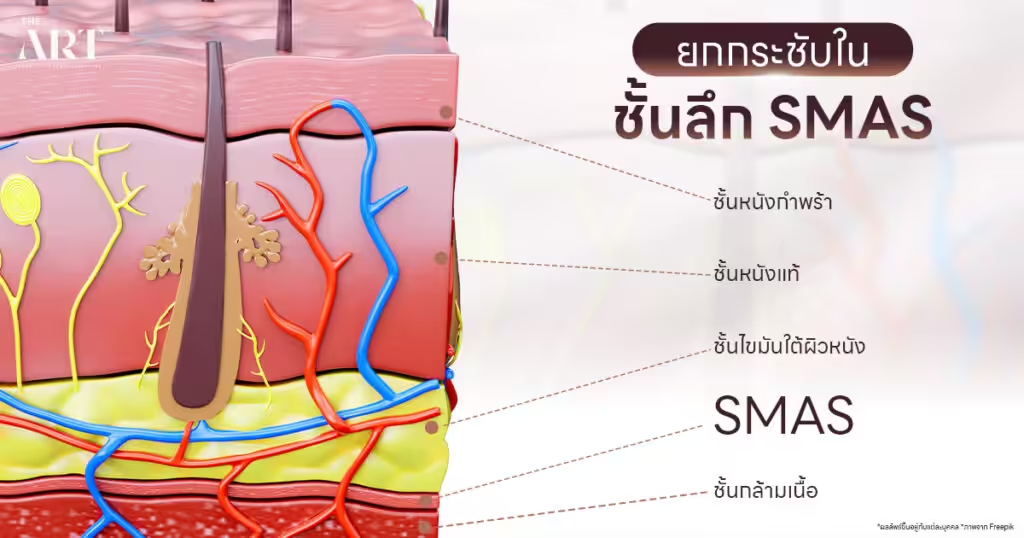
The SMAS layer is a vital structure that supports the face. Sagging in this layer can affect the entire facial appearance, leading to issues like drooping cheeks or a poorly defined jawline. Lifting at this depth ensures the results are more harmoniously aligned with the natural facial structure.
Deep Tissue Repositioning
Facial sagging is not caused by the skin alone; it also involves the displacement of fat and tissues. Deep-level repositioning helps return these tissues to a more appropriate position relative to the facial structure.
Overall Facial Balance
Improved internal balance can enhance the overall appearance, resulting in a more lifted look, proportional contours, and smoother-looking skin. Results may vary based on individual characteristics.
2. Benefits of Surgical Incisions and Scar Concealment
Another key point of interest for many is the size and placement of the surgical incisions.
Small Surgical Incisions
An endoscopic facelift uses smaller incisions compared to some other techniques, allowing the surgeon to access tissues through a limited entry point.
Inconspicuous Scars Within the Hairline
Incisions are typically placed within the hair or scalp area, making them less visible from the outside. The appearance of scars and the recovery process depend on individual factors.
3. Recovery Benefits After an Endoscopic Facelift
Recovery time is a crucial factor that many people consider when making their decision.
Recovery Period
Recovery time varies per individual depending on factors such as physical health and post-operative care. On average, patients can return to daily activities within 5–7 days, with swelling and bruising gradually subsiding within 1–2 weeks.
Factors Affecting Recovery
Factors include age, overall health, and post-operative self-care habits. It is essential to strictly follow your surgeon’s instructions.
4. Benefits of Surgical Precision
Another factor that has led to the medical adoption of endoscopic facelifts is the high level of precision during the procedure.
Enhanced Visualization of Internal Structures
The use of a small endoscope inserted through tiny incisions in the hairline allows surgeons to see sub-dermal details more clearly. This includes muscles, ligaments, and the deep muscle layer (SMAS), which are displayed accurately on a monitor.
Precision Within Limited Spaces
The endoscopic technique enables surgeons to operate through small incisions while still maintaining full access to the relevant facial structures.
Personalized Tissue Repositioning
Since every individual’s facial structure is unique, tissue repositioning requires a personalized assessment. Enhanced visibility allows surgeons to plan and adjust tissue placement to fit the specific anatomy of each patient, rather than following a “one-size-fits-all” approach.
Benefits of Endoscopic Facelifts in Relation to Age-Related Changes
Facial changes are not caused by a single factor but are the result of several interrelated elements, such as:
- Changes in the SMAS Layer — As we age, the SMAS layer, which serves as the primary support for the face, can sag, causing the overlying tissues to shift downwards.
- Displacement of Fat and Tissues — Facial fat can change in both volume and position, affecting the overall balance of the face.
- Bone Resorption — Facial bone structures gradually recede over time, reducing support points for the skin. This impacts the foundation for overlying tissues and can make sagging more pronounced.
Consequently, when sagging occurs at deeper levels, lifting the SMAS layer and structural repositioning via endoscopy is often considered more effective than merely tightening the outer skin.

Who is an Endoscopic Facelift suitable for?
- Those seeking structural lifting — Ideal for individuals who understand that facial sagging isn’t just skin-deep but involves multiple layers, such as the SMAS and supporting tissues.
- Individuals with mild to moderate sagging — Such as those experiencing early jowl formation or a loss of jawline definition.
- Those preferring smaller incisions — And the ability to conceal surgical scars within the hairline.
- Individuals with minimal excess skin.
Limitations to Consider Alongside the Benefits
While endoscopic facelifts offer numerous advantages, there are certain limitations to consider:
- In cases of severe sagging, alternative methods may be more appropriate, as each surgical technique has a different scope of treatment.
- Results vary by individual, depending on factors such as age, skin condition, facial structure, and post-operative care.
- A medical evaluation is a crucial step in choosing the right approach for each individual and understanding the treatment’s limitations.
Summary: The Benefits of an Endoscopic Facelift
The key benefits of an endoscopic facelift cover four main areas: structural lifting of the SMAS layer, small and concealable incisions, a shorter recovery time compared to some techniques, and high-precision visualization of internal structures. However, suitability varies per individual. A professional medical evaluation is essential to select an approach that aligns with your specific facial anatomy and goals.
Frequently Asked Questions About Endoscopic Facelifts (FAQ)
How does an endoscopic facelift differ from other lifting procedures?
It utilizes an endoscope to visualize internal structures and works at the deep SMAS layer of the face, unlike traditional lifting methods that primarily focus on the outer skin.
How does the endoscopic technique improve surgical precision?
It provides surgeons with a clearer view of internal tissue details within a limited space, allowing for precise tissue repositioning tailored to each individual’s unique anatomy.
Why is structural-level lifting important?
It involves repositioning the underlying tissues that cause sagging, rather than just pulling the skin. This ensures results that are more harmoniously aligned with the natural facial structure.
Which areas of the face are best suited for an endoscopic facelift?
It is highly effective for the upper and mid-face, including the forehead, outer eye area, and upper cheeks—areas where the endoscope can easily access and maneuver.
What should be considered before choosing a facial lifting method?
Key considerations include your facial structure, the degree of sagging, and medical advice. Since everyone has a unique anatomy and different levels of concerns, a professional consultation is vital.
Consult a doctor at The Art Hospital for free. No charge.
The medical team at The Art Hospital is happy to provide a consultation at no cost to assess your individual needs.
Facebook:The Art Hospital & Clinic
Line:@thearthospital
Instagram:theart.hospital
TikTok:@theartclinicandhospital
YouTube:The Art Clinic & Hospital
Call Center: 02-666-4666
References
- Aiache, A. E. (1994). Endoscopic facelift. Aesthetic plastic surgery, 18(3), 275–278. https://doi.org/10.1007/BF00449794
- Firat, M. (2025). Endoscopic Deep Plane Facelift: A Classified Approach. Aesthetic surgery journal, 45(10), 989–1001. https://doi.org/10.1093/asj/sjaf110
- Plastic Surgery Key. (n.d.). Endoscopic forehead and midface lift. https://plasticsurgerykey.com/15-endoscopic-forehead-and-midface-lift/